
Pakistan’s Carbon Credit Potential
The Untapped Billion-Dollar Opportunity
Pakistan stands at a crossroads. On one side lies the growing pressure of climate vulnerability—floods, heatwaves, smog, and water scarcity. On the other side lies a powerful, underutilized economic opportunity: carbon credits.
While countries around the world are generating billions through carbon markets, Pakistan has barely scratched the surface. With its massive agricultural base, forestry potential, and renewable energy ambitions, Pakistan could unlock a billion-dollar carbon economy with the right focus.
This blog reveals why Pakistan has this potential and how it can be turned into a national growth engine.
Introduction
Pakistan Is Sitting on a Goldmine—But Hasn’t Claimed It Yet
Carbon credits are becoming one of the fastest-growing global markets. Countries with vast agriculture, livestock, forests, and renewable potential are earning millions of dollars by reducing emissions and selling credits on international markets.
Pakistan, despite being one of the countries most affected by climate change, has barely scratched the surface of this opportunity.
But the truth is powerful:
Pakistan could generate over $1–2 billion per year through carbon credits alone.
This estimate is supported by global carbon market trends and Pakistan’s untapped potential in forestry, waste management, livestock, and renewable energy.
Pakistan’s Carbon Credit Landscape — A Sleeping Giant Awakening
Pakistan has all the ingredients to become a major carbon-credit exporting nation:
✔ 200+ million livestock → Methane reduction carbon credits
✔ 5 million hectares of degraded forest → Reforestation credits
✔ Massive rice production → Rice methane reduction credits
✔ Rising solar/biogas market → Renewable energy credits
✔ Urban waste crisis → Waste-to-energy and composting credits
Yet, Pakistan currently earns less than 1% of its potential.
Sector-Wise Breakdown: Where Pakistan Can Earn Billions
Below is a sectoral analysis with conservative revenue estimates:
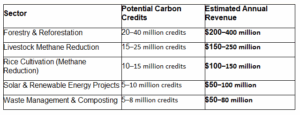
Sector Potential Carbon Credits Estimated Annual Revenue
Forestry & Reforestation 20–40 million credits $200–400 million
Livestock Methane Reduction 15–25 million credits $150–250 million
Rice Cultivation (Methane Reduction) 10–15 million credits $100–150 million
Solar & Renewable Energy Projects 5–10 million credits $50–100 million
Waste Management & Composting 5–8 million credits $50–80 million
Total Annual Potential: $550M – $1B+ per year
And this is just the beginning.
Pakistan’s Billion-Dollar Carbon Credit Opportunity
Pakistan is uniquely positioned with natural, agricultural, and renewable assets that can be transformed into carbon credits.
Here’s why the potential is massive:
1. Agriculture: Pakistan’s Biggest Goldmine for Carbon Credits
Over 60% of Pakistan’s population depends on agriculture—yet the sector emits methane, CO₂, and nitrous oxide.
High-earning carbon project types in agriculture include:
⦁ Biogas from animal dung (huge in villages)
⦁ Rice methane reduction
⦁ Manure management & composting
⦁ Agroforestry & silvopasture
Pakistan has 200+ million livestock animals.
If even 5% of dung is converted into biogas or compost, Pakistan could generate:
⦁ 10–15 million carbon credits per year
⦁ Worth $60–100 million annually at current market prices
2. Renewable Energy
Pakistan’s renewable energy potential includes:
⦁ 60,000 MW of wind
⦁ 2,900+ hours of annual sunshine
⦁ Biogas potential from villages
⦁ Large hydro & mini-hydro capacity
Each renewable project (solar, wind, hydro, biogas) can earn carbon credits for 7–10 years.
If Pakistan expands just 5% of its renewable potential, it could unlock:
⦁ $300–500 million per year in carbon credit revenue.
3. Forestry & Land Restoration: The Fastest Growing Carbon Asset.
Pakistan has already gained international attention through the Billion Tree Tsunami.
But the country still faces massive deforestation.
Opportunities in forestry include:
⦁ Reforestation
⦁ Avoided deforestation
⦁ Mangrove restoration
⦁ Urban forestry
Mangroves alone can sequester up to 4x more carbon than terrestrial forests.
If Pakistan restores just 200,000 hectares, it could generate:
⦁ 30 million credits over 20 years
⦁ Worth $150–300 million
4. Waste Management: Pakistan’s Low-Hanging Fruit
Cities like Lahore, Karachi, and Faisalabad generate thousands of tons of waste daily.
With proper projects, Pakistan could earn credits from:
⦁ Landfill gas capture
⦁ Waste-to-energy plants
⦁ Organic waste composting
⦁ Plastic recycling (EPR credits)
Even one city, if optimized, could generate 1–3 million credits yearly.
What Pakistan Needs to Unlock Its Billion-Dollar Opportunity
Key Actions Required:
⦁ Government carbon policy & Marketplace
⦁ National MRV (Monitoring, Reporting, Verification) System
⦁ Training of local developers & consultants
⦁ Partnerships with global carbon buyers
⦁ Fast-track carbon project approvals
How Small Companies & Startups Can Enter the Carbon Market
This is not just for large corporations—even small companies can generate and sell carbon credits.
✔ Ways a Small Business Can Participate
⦁ Start biogas projects
⦁ Plant forests on leased land
⦁ Upgrade to solar systems
⦁ Invest in energy efficiency measures
⦁ Partner with carbon project developers
✔ Required Steps
⦁ Project Design Document (PDD)
⦁ Baseline scenario calculation
⦁ Monitoring plan
⦁ Third-party verification
⦁ Registration on Verra, Gold Standard, or GCC
A small company can make $10,000–$300,000 annually from carbon credits depending on project scale.
Conclusion: The Time for Pakistan to Act Is NOW
Pakistan has everything required to lead the global carbon market:
⦁ Massive natural resources
⦁ Huge livestock sector
⦁ Millions of hectares available for reforestation
⦁ Rapidly growing renewable energy capacity
With proper policy, Pakistan can earn $1–2 billion every year.
This is not just an environmental opportunity; it is an economic revolution waiting to happen.